
Financial Ratios (Comparables) Analysis   22-slide PPT PowerPoint presentation slide deck (PPT)
$39.00

Financial Ratios (Comparables) Analysis (22-slide PPT PowerPoint presentation slide deck (PPT)) Preview Image
Log in to unlock full preview.
Financial Ratios (Comparables) Analysis (22-slide PPT PowerPoint presentation slide deck (PPT)) Preview Image
Arrow   Click main image to view in full screen.

Financial Ratios (Comparables) Analysis (PowerPoint PPT Slide Deck)

PowerPoint (PPT) 22 Slides

#3 in Financial Analysis $39.00
This presentation is created by former McKinsey, BCG, Deloitte, EY, and Capgemini consultants. It delineates the most critical strategic ratios for Financial Ratios/Comparables Analysis.
Add to Cart


Immediate download
Free lifetime updates

FINANCIAL ANALYSIS PPT DESCRIPTION

Financial Ratios (Comparables) Analysis is a 22-slide PowerPoint presentation by LearnPPT Consulting that outlines 20 widely used financial ratios for evaluating profitability, liquidity, solvency, and investment metrics. Developed by former McKinsey, BCG, Deloitte, EY, and Capgemini consultants, it includes a financial analysis framework template, a ratio analysis spreadsheet model, a Dupont Tree visual, case examples, and guidance on data sources. Target users are corporate executives, financial analysts, consultants, and investment professionals. Sold as a digital download on Flevy.
Use this deck when an organization needs to assess company financial health and competitive positioning—such as during performance reviews, benchmarking exercises, investor preparations, or financial literacy training.
  Corporate executives assessing cash flow trends and strategic positioning as part of annual planning.
  Financial analysts benchmarking profitability and liquidity ratios against industry peers using a ratio analysis spreadsheet model.
  Consultants diagnosing performance issues by building Dupont Tree visualizations and recommending ratio-driven interventions.
  Investment professionals evaluating market metrics and investment ratios for due diligence.
The structured workflow of defining, calculating, benchmarking, and interpreting ratios mirrors the consulting-grade analytical rigor associated with McKinsey, Bain, and BCG.

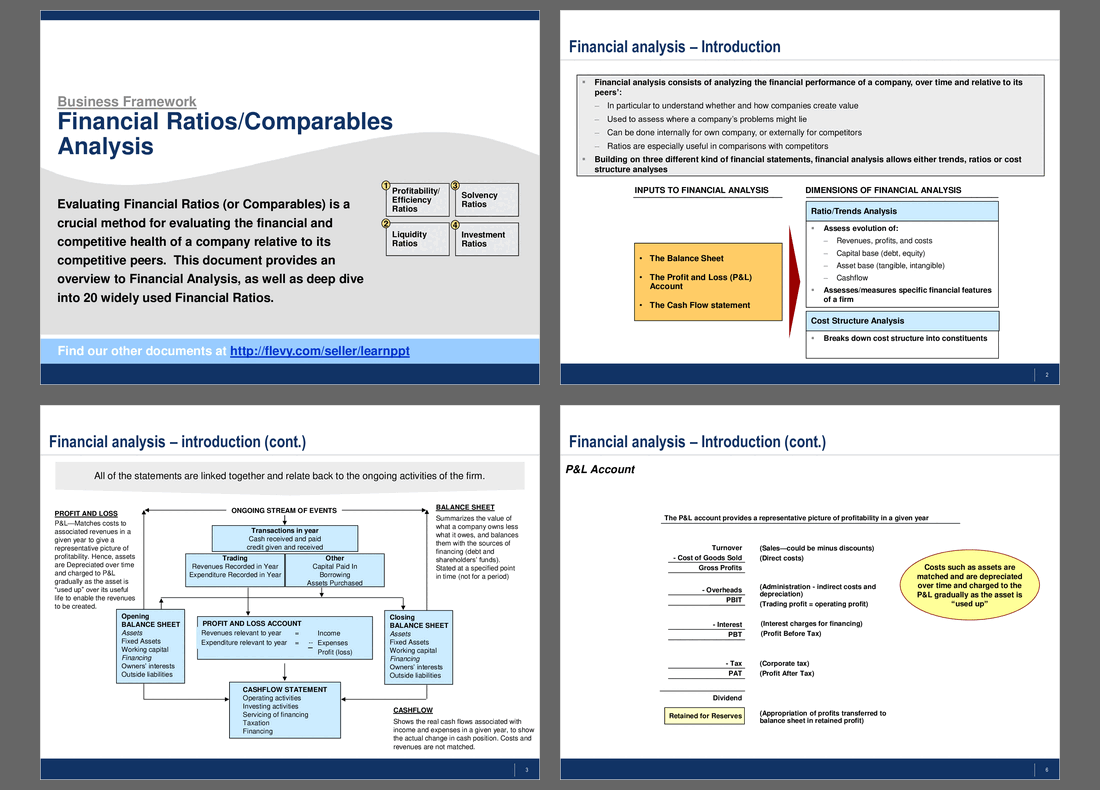
Evaluating Financial Ratios (or Financial Comparables) is a crucial method for evaluating the financial and competitive health of a company relative to its competitive peers. This document provides an overview to Financial Analysis, as well as deep dive into 20 widely used Financial Ratios.

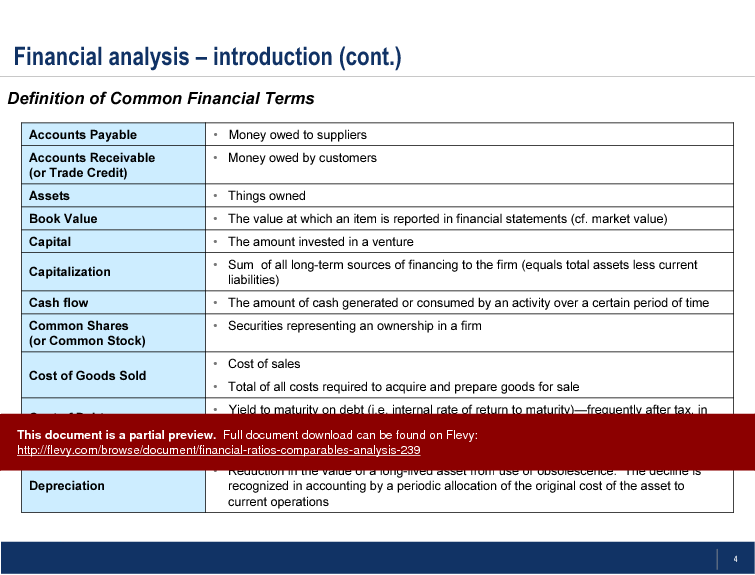
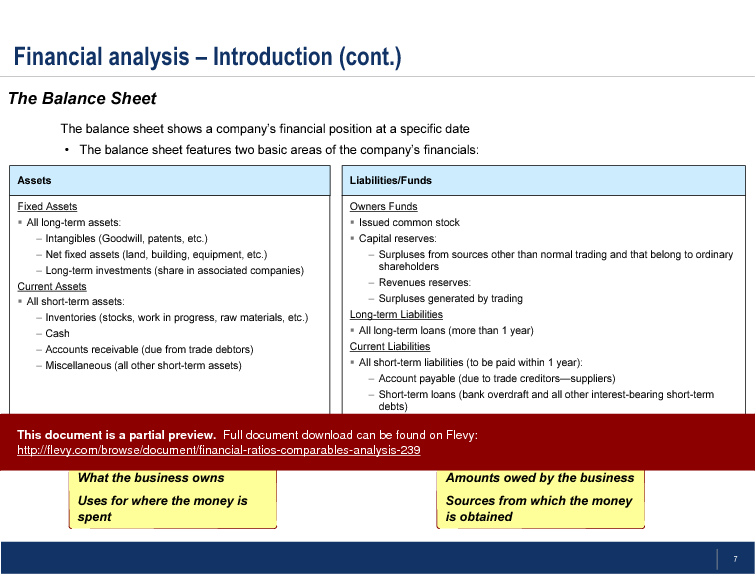
This comprehensive document delves into the intricacies of financial ratio analysis, offering a robust framework for understanding key financial metrics. It starts with a clear definition of common financial terms, ensuring that users have a solid foundation before diving into more complex analyses. The balance sheet section meticulously breaks down assets and liabilities, providing a snapshot of a company's financial health at a specific point in time.

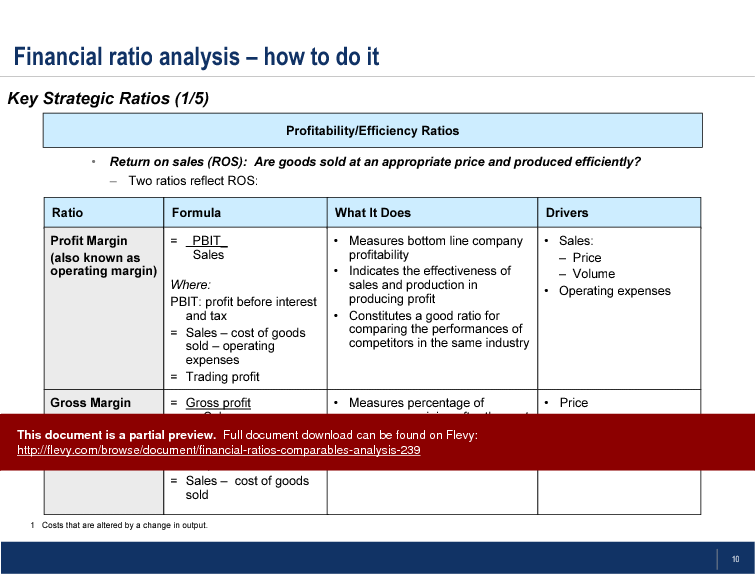
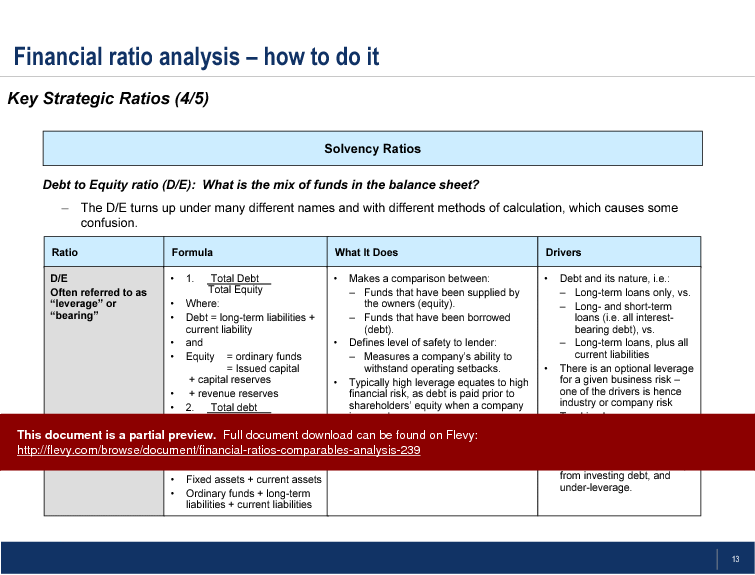
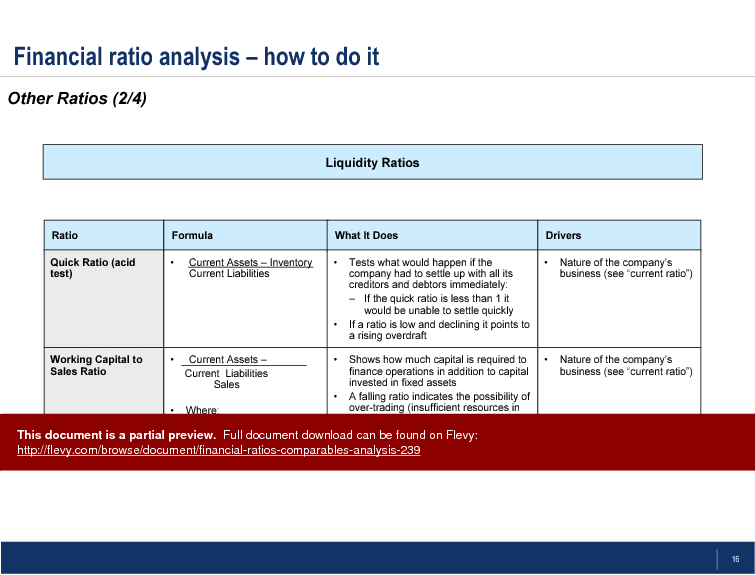
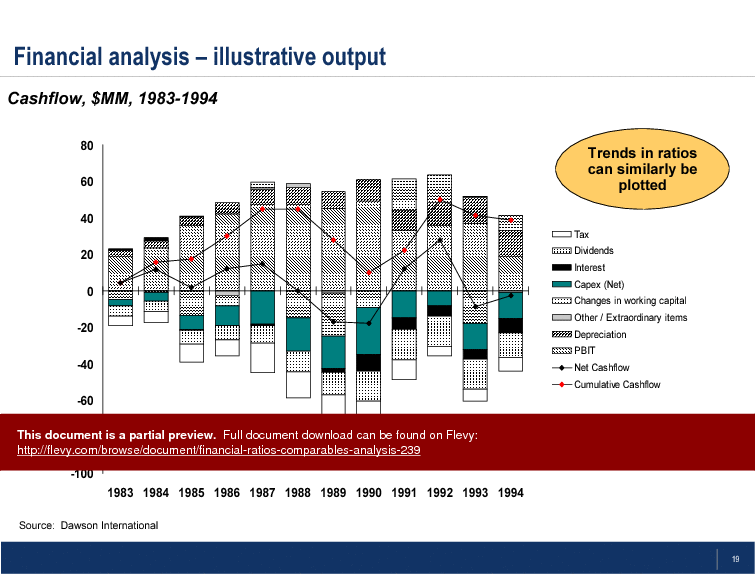
Key strategic ratios are explored in depth, covering profitability, efficiency, solvency, and liquidity ratios. Each ratio is presented with its formula, what it measures, and the primary drivers behind it. This structured approach allows executives to quickly grasp the significance of each ratio and how it impacts overall financial performance. The document also includes illustrative outputs, such as cash flow trends, to visualize how these ratios play out over time.

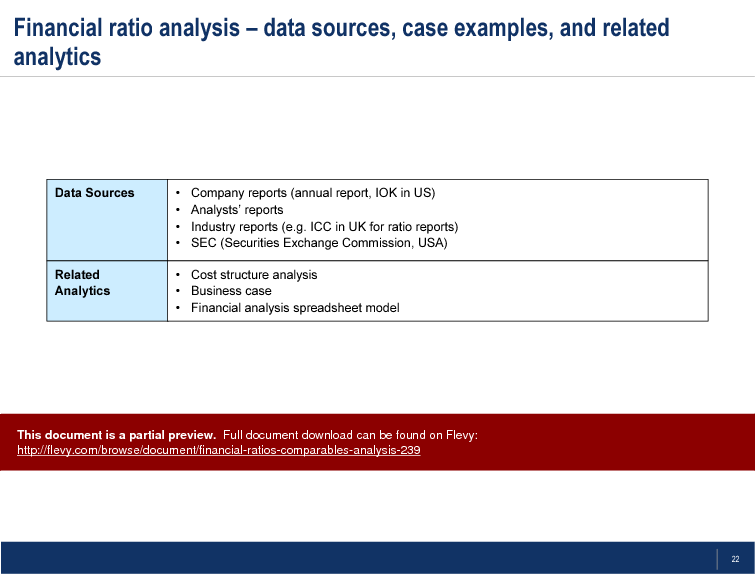
The final sections of the document highlight data sources, case examples, and related analytics. This ensures that users can not only understand and calculate financial ratios, but also apply them in real-world scenarios. The inclusion of industry reports, analyst reports, and SEC filings as data sources underscores the document's practical utility. This is an essential resource for any executive looking to enhance their financial analysis capabilities.

Got a question about the product? Email us at support@flevy.com or ask the author directly by using the "Ask the Author a Question" form. If you cannot view the preview above this document description, go here to view the large preview instead.

MARCUS OVERVIEW

This synopsis was written by Marcus [?] based on the analysis of the full 22-slide presentation.


Executive Summary
This presentation on Financial Ratios/Comparables Analysis is crafted by former consultants from McKinsey, BCG, Deloitte, EY, and Capgemini, ensuring a McKinsey, Bain, or BCG-quality approach (consulting-grade; not affiliated). It provides a comprehensive overview of financial analysis, emphasizing the evaluation of a company’s financial and competitive health through 20 widely used financial ratios. Buyers will gain insights into profitability, liquidity, solvency, and investment ratios, enabling them to make informed strategic decisions regarding company performance and competitive positioning.

Who This Is For and When to Use

•  Corporate executives seeking to assess financial health and competitive positioning
•  Financial analysts tasked with evaluating company performance against peers
•  Consultants advising clients on financial strategy and performance improvement
•  Investment professionals analyzing potential investment opportunities

Best-fit moments to use this deck:

•  During financial performance reviews and strategic planning sessions
•  When conducting competitive analysis or benchmarking exercises
•  In preparation for investor presentations or stakeholder meetings
•  For training sessions focused on financial literacy and ratio analysis

Learning Objectives

•  Define key financial ratios and their significance in evaluating company performance
•  Analyze profitability, liquidity, solvency, and investment ratios to assess financial health
•  Compare financial ratios against industry peers to identify strengths and weaknesses
•  Interpret financial statements to derive actionable insights for strategic decision-making
•  Build a comprehensive financial analysis framework using the provided ratios
•  Identify trends in financial performance over time to inform future strategies

Table of Contents

•  Introduction to Financial Analysis (page 2)
•  Key Strategic Ratios Overview (page 9)
•  Profitability/Efficiency Ratios (page 10)
•  Liquidity Ratios (page 16)
•  Solvency Ratios (page 19)
•  Investment Ratios (page 14)
•  Illustrative Outputs and Case Examples (page 19)
•  Tips for Effective Ratio Analysis (page 21)
•  Data Sources and Related Analytics (page 22)

Primary Topics Covered

•  Financial Analysis Overview - An introduction to financial analysis, detailing its importance in evaluating a company's performance relative to peers.
•  Profitability Ratios - Ratios that measure a company's ability to generate profit relative to sales, assets, and equity.
•  Liquidity Ratios - Ratios assessing a company's ability to meet short-term obligations and manage cash flow effectively.
•  Solvency Ratios - Ratios that indicate a company's financial strength and its ability to withstand operational setbacks.
•  Investment Ratios - Ratios that reflect market perceptions of a company, primarily used by investors to assess value.
•  Illustrative Outputs - Examples of cash flow trends and financial models like the Dupont Tree for visualizing financial performance.

Deliverables, Templates, and Tools

•  Financial analysis framework template for evaluating company performance
•  Ratio analysis spreadsheet model for calculating and comparing key financial ratios
•  Case study examples illustrating the application of financial ratios in real-world scenarios
•  Guidelines for interpreting financial statements and deriving insights
•  Visual aids such as the Dupont Tree model for presenting financial data

Slide Highlights

•  Overview slide detailing the importance of financial ratios in assessing company health
•  Key strategic ratios slide summarizing profitability, liquidity, solvency, and investment ratios
•  Cash flow trend analysis visual showcasing financial performance over time
•  Dupont Tree model slide illustrating the relationship between financial metrics and shareholder value
•  Tips for effective ratio analysis slide emphasizing best practices and common pitfalls

Potential Workshop Agenda

Introduction to Financial Ratios (30 minutes)
•  Overview of financial analysis and its significance
•  Discussion of key financial statements and their interconnections

Ratio Analysis Techniques (60 minutes)
•  Deep dive into profitability, liquidity, solvency, and investment ratios
•  Hands-on exercises calculating and interpreting key ratios

Case Study Review (45 minutes)
•  Analyze a real-world company’s financial ratios
•  Group discussion on findings and strategic implications

Best Practices in Financial Analysis (30 minutes)
•  Tips for effective ratio analysis and common pitfalls to avoid
•  Q&A session to address participant queries

Customization Guidance

•  Tailor ratio analysis examples to reflect industry-specific benchmarks and standards
•  Adjust the financial analysis framework to align with organizational goals and metrics
•  Incorporate company-specific financial statements for more relevant analysis
•  Modify visual aids to represent internal data and trends for stakeholder presentations

Secondary Topics Covered

•  Cost structure analysis and its role in financial evaluation
•  Trends in financial performance and their implications for strategy
•  The importance of comparing ratios over time and against industry peers
•  Common accounting principles and their impact on ratio comparisons

Topic FAQ

What are the main categories of financial ratios I should focus on for company health assessment?
Financial ratio analysis typically groups metrics into profitability, liquidity, solvency, and investment categories. Profitability evaluates profit generation, liquidity measures short-term cash capacity, solvency assesses long-term financial strength, and investment ratios reflect market perceptions. These 4 categories are central to the toolkit's framework: profitability, liquidity, solvency, and investment ratios.

How does a Dupont Tree help me understand return on equity in practice?
The Dupont Tree provides a visual breakdown showing how different financial metrics combine to affect shareholder value, helping identify which underlying drivers explain changes in return on equity. It is presented as a visualization tool within the deck to link metric movements to ROE in the Dupont Tree model.

How often should a company perform ratio and comparables analysis to track performance?
Regular analysis is recommended to monitor trends and inform decisions; the guidance suggests performing ratio analysis at least on an annual or quarterly basis. Routine comparisons over time and against peers support trend identification and strategic adjustments, typically on an annual or quarterly cadence.

What should I look for when choosing a comparables/ratio analysis toolkit for my team?
Prioritize coverage of standard ratio categories, inclusion of calculation templates or a ratio analysis spreadsheet model, explanatory notes on interpretation, example outputs such as cash flow trends or Dupont visuals, and data source guidance. The product Financial Ratios (Comparables) Analysis documents 20 widely used ratios and a spreadsheet model.

How much time and what format are typical for training a team on ratio analysis?
A concise workshop agenda in the material covers an introduction, deep-dive techniques, a case study review, and best-practice discussion totaling about 165 minutes. That agenda structure supports hands-on calculation, interpretation, and group discussion within a roughly three-hour training session.

I need to benchmark profitability against peers—what practical steps should I follow?
Define which profitability ratios to use, extract necessary items from financial statements, calculate ratios consistently across firms, adjust for accounting differences, and interpret drivers using visual tools like the Dupont Tree. Flevy's Financial Ratios (Comparables) Analysis provides templates and case examples to support those steps and profitability ratios.

Can ratio and comparables analysis be used to support investor due diligence and valuation?
Yes; investment ratios and cash flow trend analysis help investors assess market perceptions, growth prospects, and value signals. Using standardized calculations and peer benchmarking improves comparability, and the deck includes investment ratios and cash flow trend visuals to support due diligence work.

How should I assess the cost versus value of buying a ratio analysis template pack instead of building one in-house?
Compare the deliverables and time savings against internal build costs: a prebuilt pack should include a slide framework, a ratio analysis spreadsheet model, interpretation guidance, and case examples. Financial Ratios (Comparables) Analysis bundles a 22-slide deck, spreadsheet model, and case examples to inform that comparison.

Document FAQ

What are financial ratios?
Financial ratios are quantitative measures used to assess a company's financial performance and health by comparing different financial metrics.

Why are profitability ratios important?
Profitability ratios indicate how effectively a company generates profit from its sales and assets, providing insights into operational efficiency.

How do liquidity ratios help in financial analysis?
Liquidity ratios assess a company's ability to meet short-term obligations, helping to gauge its financial stability and cash flow management.

What do solvency ratios indicate?
Solvency ratios measure a company's financial strength and its ability to withstand operational challenges, focusing on the balance between debt and equity.

How can investment ratios assist investors?
Investment ratios provide insights into market perceptions of a company, helping investors evaluate potential returns and growth prospects.

What is the significance of the Dupont Tree model?
The Dupont Tree model visually represents the relationship between various financial metrics, helping to analyze factors contributing to shareholder value.

How can I ensure accurate ratio comparisons?
Ensure that you are comparing like with like by considering industry standards, accounting principles, and the context of the financial data.

What are common pitfalls in ratio analysis?
Common pitfalls include drawing conclusions from a single ratio, overlooking industry differences, and failing to consider the context of financial statements.

How often should financial ratios be analyzed?
Regular analysis, ideally on an annual or quarterly basis, helps track performance trends and inform strategic decision-making.

Glossary

•  Accounts Payable - Money owed to suppliers.
•  Accounts Receivable - Money owed by customers.
•  Assets - Things owned by a company.
•  Cash Flow - The amount of cash generated or consumed by an activity over a certain period.
•  Debt to Equity Ratio - A measure of a company's financial leverage calculated by dividing total liabilities by shareholders' equity.
•  Liquidity - The extent to which a company has assets readily available to meet obligations.
•  Profit Margin - A profitability ratio calculated as profit before interest and tax divided by sales.
•  Return on Equity (ROE) - A measure of financial performance calculated by dividing net income by shareholders' equity.
•  Solvency - The ability of a company to meet its long-term debts and financial obligations.
•  Working Capital - Current assets minus current liabilities, indicating the liquidity available for day-to-day operations.

FINANCIAL ANALYSIS PPT SLIDES

Structured Financial Analysis Using the RONA Model

Comprehensive Overview of Financial Ratios

Foundational Overview of Financial Analysis Methods

P&L Account Structure and Profitability Insights

Key Profitability and Efficiency Ratios Overview

Interconnected Financial Statements and Their Implications

Historical Cash Flow Analysis: 1983-1994 Trends

Source: Best Practices in Financial Analysis, M&A PowerPoint Slides: Financial Ratios (Comparables) Analysis PowerPoint (PPT) Presentation Slide Deck, LearnPPT Consulting


$39.00
This presentation is created by former McKinsey, BCG, Deloitte, EY, and Capgemini consultants. It delineates the most critical strategic ratios for Financial Ratios/Comparables Analysis.
Add to Cart
  

ABOUT THE AUTHOR

Author image
Additional documents from author: 141

We are a team of management consultants trained by top tier global consulting firms (including McKinsey, BCG, Deloitte, EY, Capgemini) with a collective experience of several decades. We specialize in business frameworks based on real-life consulting engagements.

We have served 100s of clients that range from Fortune 500 companies to tech startups to ... [read more]

Ask the Author a Question

You must be logged in to contact the author.

Click here to log in Click here register

Did you know?
The average daily rate of a McKinsey consultant is $6,625 (not including expenses). The average price of a Flevy document is $65.

Bundle and save! You can save up to % with bundles!

View bundle(s)


Trusted by over 10,000+ Client Organizations
Since 2012, we have provided business templates to over 10,000 businesses and organizations of all sizes, from startups and small businesses to the Fortune 100, in over 130 countries.
AT&T GE Cisco Intel IBM Coke Dell Toyota HP Nike Samsung Microsoft Astrazeneca JP Morgan KPMG Walgreens Walmart 3M Kaiser Oracle SAP Google E&Y Volvo Bosch Merck Fedex Shell Amgen Eli Lilly Roche AIG Abbott Amazon PwC T-Mobile Broadcom Bayer Pearson Titleist ConEd Pfizer NTT Data Schwab


Read Customer Testimonials

 
"Flevy.com has proven to be an invaluable resource library to our Independent Management Consultancy, supporting and enabling us to better serve our enterprise clients.

The value derived from our [FlevyPro] subscription in terms of the business it has helped to gain far exceeds the investment made, making a subscription a no-brainer for any growing consultancy – or in-house strategy team."

– Dean Carlton, Chief Transformation Officer, Global Village Transformations Pty Ltd.
 
"As a young consulting firm, requests for input from clients vary and it's sometimes impossible to provide expert solutions across a broad spectrum of requirements. That was before I discovered Flevy.com.

Through subscription to this invaluable site of a plethora of topics that are key and crucial to consulting, I "

– Nishi Singh, Strategist and MD at NSP Consultants
 
"FlevyPro has been a brilliant resource for me, as an independent growth consultant, to access a vast knowledge bank of presentations to support my work with clients. In terms of RoI, the value I received from the very first presentation I downloaded paid for my subscription many times over! The "

– Roderick Cameron, Founding Partner at SGFE Ltd
 
"As a consultant requiring up to date and professional material that will be of value and use to my clients, I find Flevy a very reliable resource.

The variety and quality of material available through Flevy offers a very useful and commanding source for information. Using Flevy saves me time, enhances my expertise and ends up being a good decision."

– Dennis Gershowitz, Principal at DG Associates
 
"Last Sunday morning, I was diligently working on an important presentation for a client and found myself in need of additional content and suitable templates for various types of graphics. Flevy.com proved to be a treasure trove for both content and design at a reasonable price, considering the time I "

– M. E., Chief Commercial Officer, International Logistics Service Provider
 
"One of the great discoveries that I have made for my business is the Flevy library of training materials.

As a Lean Transformation Expert, I am always making presentations to clients on a variety of topics: Training, Transformation, Total Productive Maintenance, Culture, Coaching, Tools, Leadership Behavior, etc. Flevy "

– Ed Kemmerling, Senior Lean Transformation Expert at PMG
 
"As a consulting firm, we had been creating subject matter training materials for our people and found the excellent materials on Flevy, which saved us 100's of hours of re-creating what already exists on the Flevy materials we purchased."

– Michael Evans, Managing Director at Newport LLC
 
"The wide selection of frameworks is very useful to me as an independent consultant. In fact, it rivals what I had at my disposal at Big 4 Consulting firms in terms of efficacy and organization."

– Julia T., Consulting Firm Owner (Former Manager at Deloitte and Capgemini)


Save with Bundles

This document is available as part of the following discounted bundle(s):

Save %!
Competitive and Company Cost Analysis

This bundle contains 5 total documents. See all the documents to the right.

$129.00


Add Bundle & Save


Customers Also Bought These Documents


Customers Also Like These Documents

Explore Related Management Topics


Your Recently Viewed Documents
Download our FREE Strategy & Transformation Framework Templates

Download our free compilation of 50+ Strategy & Transformation slides and templates. Frameworks include McKinsey 7-S, Balanced Scorecard, Disruptive Innovation, BCG Curve, and many more.